
Design and Implementation of an Interactive Virtual Library based on its Physical Counterpart
Overview
This work explores the creation of a digital replica of a physical library using photogrammetry and 3D modelling. A Virtual Reality (VR) platform is developed to immerse users in a virtual library experience that can act as a community and knowledge hub, emphasizing 24/7 access, functionality, and interactivity. A perceptual study and a user evaluation study assess current usage of physical libraries, user experience in VR, and expectations from virtual counterparts, guiding the design of five key usage scenarios.
Abstract
The rapid technological advancements and the widespread adoption of the internet have diminished the role of the physical library as a main information resource. As the Metaverse is evolving, a revolutionary change is anticipated in how social relationships are perceived, within an educational context. It is therefore necessary for libraries to upgrade the services they provide to keep in line with the technological trends and be a part of this virtual revolution. It is believed that the design and development of a Virtual Reality (VR) library can be the community and knowledge hub the society needs.
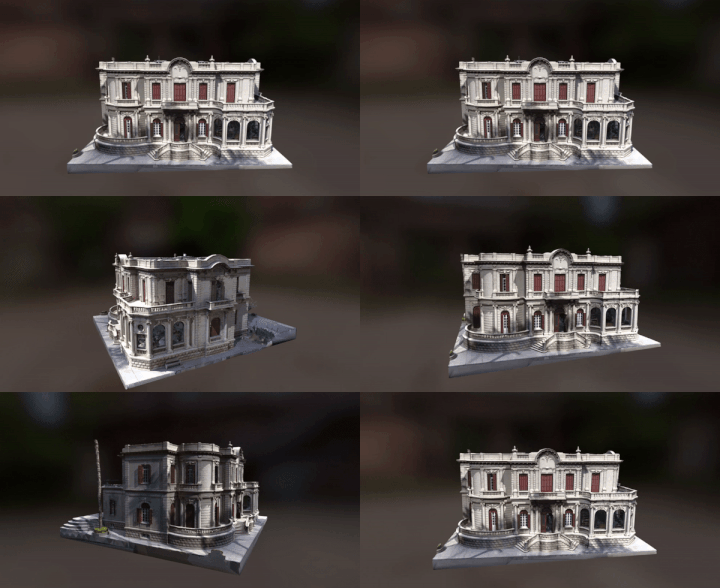
In this paper, the process of creating a partially digital replica of the Limassol Municipal University Library, a landmark for the city of Limassol, is examined by using photogrammetry and 3D modelling. A 3D platform was developed, where users have the perception that they are experiencing the actual library. To that end, a perceptual study was conducted, to understand the current usage of physical libraries, examine the users’ experience in VR, and identify the requirements and expectations in the development of a virtual library counterpart.
Following the suggestions and observations from the perceptual study, five key scenarios were implemented that demonstrate the potential use of a virtual library. This work incorporates the fundamental VR attributes, such as immersiveness, realism, user interactivity and feedback as well as other features, such as animated NPCs, 3D audio, ray-casting and GUIs, that significantly augment the overall VR library user experience, presence as well as navigation autonomy. The main effort of this project was to produce a VR representation of an existing physical library, integrated with its key services, as a proof-of-concept, with emphasis on easy 24/7 access, functionality, and interactivity. A detailed user evaluation study was conducted upon completion of the final VR library implementation, which firmly confirmed all its key attributes and future viability.
Other Related Publications
Main Contributions
- We have designed and developed a 3D virtual library, setting the foundation for the technological advances needed to be integrated in libraries in the general concept of a virtual environment/Metaverse.
- We reconstructed the Limassol Municipal University Library, in the aspect of a digital twin, using photogrammetry and 3D modelling. The aim was to create a proof-of-concept of a more engaging and interactive 3D virtual environment that would provide a rich and fulfilling experience to the user.
- We conducted a perceptual study to understand the current use of the library, and the limitations physical libraries present.
- We sketched the profile of potential users of a virtual library, and understood their needs and expectations.
- We implemented five basic scenarios that users can meet in real-world cases: taking a virtual tour, borrowing a book/proceedings via an online platform, attending or organizing a seminar/conference, booking a meeting room to participate in a group meeting (upon invitation), or meeting with a specialized mentor.
- We conducted a user evaluation study to assess the VR library’s functionality, usability and practical effectiveness, as well as to evaluate the level of immersion, realism and satisfaction in the virtual environment. Results verified that the above features have been adequately achieved and strongly endorsed by the participants.
Interactive 3D Model
BibTeX
@article{Serghides:2024,
 author    	= {Serghides, Christina-Georgia and Christoforides, George and Iakovides, Nikolas and Aristidou, Andreas},
 title     	= {Design and implementation of an interactive virtual library based on its physical counterpart},
 doi 	  	= {10.1007/s10055-024-01023-x},
 journal   	= {Virtual Reality},
 volume    	= {28},
 number    	= {3},
 issn	  	= {1434-9957},
 pages     	= {128},
 publisher 	= {Springer Berlin/Heidelberg},
 year      	= {2024}
}
Acknowledgments
We would like to express our acknowledgements to the staff of the University of Cyprus Library (Elena Diomidi-Parpouna, Anna Mousena, Vasoula Philippou, Angeliki Matsa, Stavroula Pitta); the Limassol Municipal University Library for their permission to scan the building (Georgia Kontolemi); Melios Agathangelou for his help with the scanning of the building using a drone; and Andreas Andreou for his fruitful discussions about the Unity implementations. Finally, we would like to thank all the participants of the perceptual and evaluation studies.