Underwater Virtual Exploration of the Ancient Port of Amathus
Overview
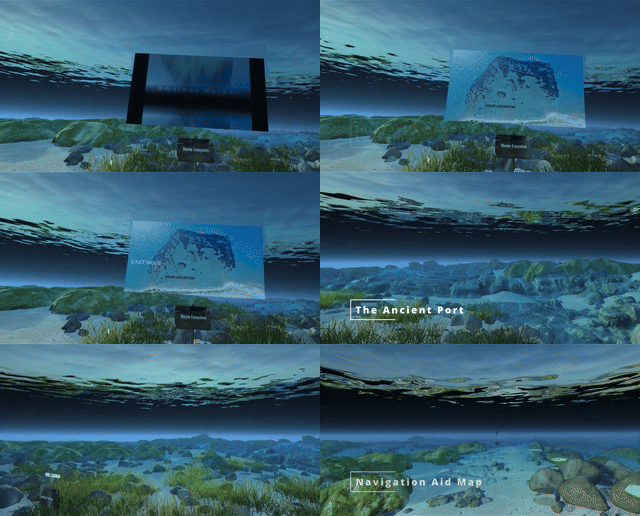
This work focuses on the digital reconstruction and visualization of underwater cultural heritage, presenting a gamified virtual reality experience of the ancient harbor of Amathus in Cyprus. Through photogrammetry-based 3D documentation, VR exploration, guided tours, and AI-driven enhancements, the system enables realistic, immersive, and educational underwater experiences while supporting conservation and public engagement.
Abstract
Underwater cultural heritage sites, spanning from submerged settlements to ancient ports and shipwrecks, captivate researchers and the public, providing insight into civilizations along coastlines and riverbanks. However, their accessibility and exploration are hindered by the sea’s physical barrier. Virtual Reality (VR) offers a transformative solution by providing digital accessibility to these underwater artifacts, enabling immersive exploration without physical limitations. VR enables people to embark on virtual tours of these sites, fostering a deeper appreciation of maritime archaeology and cultural heritage. Yet, fully realizing VR’s potential in underwater environments poses challenges, such as realistic virtual reconstruction and accurate simulation of marine life and coral reefs. Photogrammetry emerges as an effective technique for creating detailed 3D models, although underwater conditions often hinder quality outcomes. To address these challenges, our work focuses on digital underwater cultural heritage, presenting a gamified VR exploration of the ancient harbor of Amathus in Cyprus. Through photogrammetry, our VR environment enables users to explore and interact with the historic site seamlessly. Integrated guided tours, procedural generation, and machine learning algorithms enhance realism and user engagement. Evaluation through user studies demonstrates high-quality VR experiences with minimal discomfort, highlighting the efficacy and potential impact of our approach in enhancing underwater exploration and conservation efforts.
Main Contributions
- Digital Exploration of Amathus Harbor: An immersive VR experience for exploring the ancient harbor of Amathus in Cyprus using 3D documentation and reconstruction.
- Immersive VR Technology: A unique blend of education and entertainment leveraging VR technology and procedural techniques, transcending traditional presentation methods.
- 3D Photogrammetry & Guided Tours: A comprehensive underwater photogrammetric 3D model of the harbor, enhanced with guided tour functionality for authentic and interactive exploration.
- Procedural Generation & Machine Learning: Procedurally generated flora and lifelike fauna motion via machine learning, significantly increasing environmental richness and realism.
- User & Expert Evaluations: A user study with 30 participants and expert evaluations indicating high-quality immersion, minimal cybersickness, and insights for content and navigation improvements.
Video
BibTeX
@article{Alexandrou:2024,
 author    	= {Alexandrou, Antreas and Skola, Filip and Skarlatos, Dimitrios and Demesticha, Stella and Liarokapis, Fotis and Aristidou, Andreas},
 title     	= {Underwater virtual exploration of the ancient port of Amathus},
 journal   	= {Journal of Cultural Heritage},
 issue_date	= {November–December 2024},
 volume    	= {70},,
 pages 		= {181-193},
 year 		= {2024},
 month     	= {nov},
 issn 		= {1296-2074},
 doi 		= {10.1016/j.culher.2024.09.006},
 publisher 	= {Elsevier},
}
Acknowledgments
This project has received funding from the University of Cyprus (project: Demonstration); the European Union’s Horizon 2020 Research and Innovation Programme under Grant Agreement No 739578 and the Government of the Republic of Cyprus through the Deputy Ministry of Research, Innovation and Digital Policy; and the European Union under Grant Agreement No 101093159. Special thanks are also owed to the ANDIKAT project team, for sharing the photogrammetric data that were used for this application. The authors would also like to express their gratitude to Kalliopi Apostolou for her valuable insights on the user study.