
Salsa dance learning evaluation and motion analysis in gamified virtual reality environment
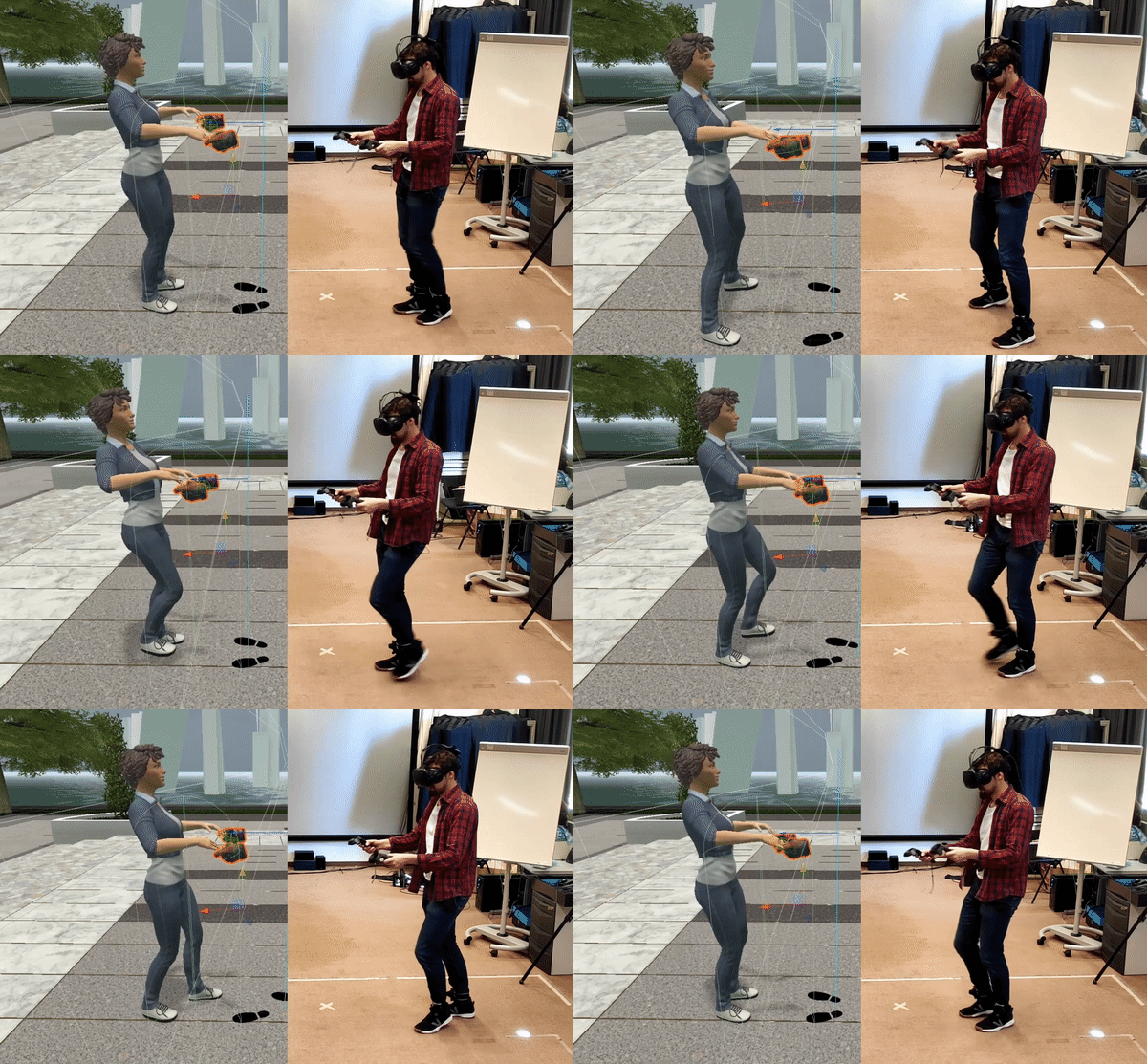
Overview
This work introduces an interactive learning application in the form of a gamified virtual reality environment that helps users improve their salsa dancing skills. The system combines a virtual partner with interactive control, visual and haptic feedback, and game mechanics with dance tasks. Learning is evaluated using Musical Motion Features and Laban Motion Analysis before and after training, demonstrating convergence of non-dancers toward the profiles of regular dancers.
Abstract
Learning couple dance such as salsa is challenging as it requires to understand and assimilate all the dance skills (guidance, rhythm, style) correctly. Salsa is traditionally learned by attending a dancing class with a teacher and practice with a partner, the difficulty to access such classes though, and the variability of dance environment can impact the learning process.
Understanding how people learn using a virtual reality platform could bring interesting knowledge in motion analysis and can be the first step toward a complementary learning system at home. In this paper, we propose an interactive learning application in the form of a virtual reality game, that aims to help the user to improve its salsa dancing skills. The application was designed upon previous literature and expert discussion and has different components that simulate salsa dance: a virtual partner with interactive control to dance with, visual and haptic feedback, and a game mechanic with dance tasks.
This application is tested on a two-class panel of 20 regular and 20 non-dancers, and their learning is evaluated and analyzed through the extraction of Musical Motion Features and the Laban Motion Analysis system. Both motion analysis frameworks were compared prior and after training and show a convergence of the profile of non-dancer toward the profile of regular dancers, which validates the learning process. The work presented here has profound implications for future studies of motion analysis, couple dance learning, and human–human interaction.
Main Contributions
- A VR environment that guides and helps users practice and improve their dancing skills through dance gamification and interaction with a virtual avatar, while providing seamless motion capture for further analysis and studies.
- A motion analysis framework that evaluates the influence of the application on users’ dance skills in terms of guidance, rhythm, and style, by extracting, evaluating, and validating key Musical Motion Features (MMF) and Laban Motion Analysis (LMA) descriptors using a two-class dataset of regular and non-dancers synchronized with music.
Video
Media Coverage
BibTeX
@article{Senecal:2020:MultTool,
 author    	= {Senecal, Simon and Nijdam, Niels A. and Aristidou, Andreas and Magnenat-Thalmann, Nadia},
 title    	= {Salsa dance learning evaluation and motion analysis in gamified virtual reality environment},
 journal 	= {Multimedia Tools and Applications},
 volume 	= {79},
 number 	= {33-34},
 month 		= jun,
 year 		= {2020},
 issn 		= {1573-7721},
 pages 		= {24621–24643},
 numpages	= {23},
 url 		= {https://doi.org/10.1007/s11042-020-09192-y},
 doi 		= {10.1007/s11042-020-09192-y},
 publisher 	= {Springer},
 address 	= {},
}
Acknowledgments
This work is co-financed by the European project MINGEI. It was also partially supported by the European Union's Horizon 2020 research and innovation programme H2020-WIDESPREAD-01-2016-2017-Teaming Phase 2 under grant agreement No 739578.