
Mixed Reality in Electronic Health Records: User Requirements and Evaluation
Overview
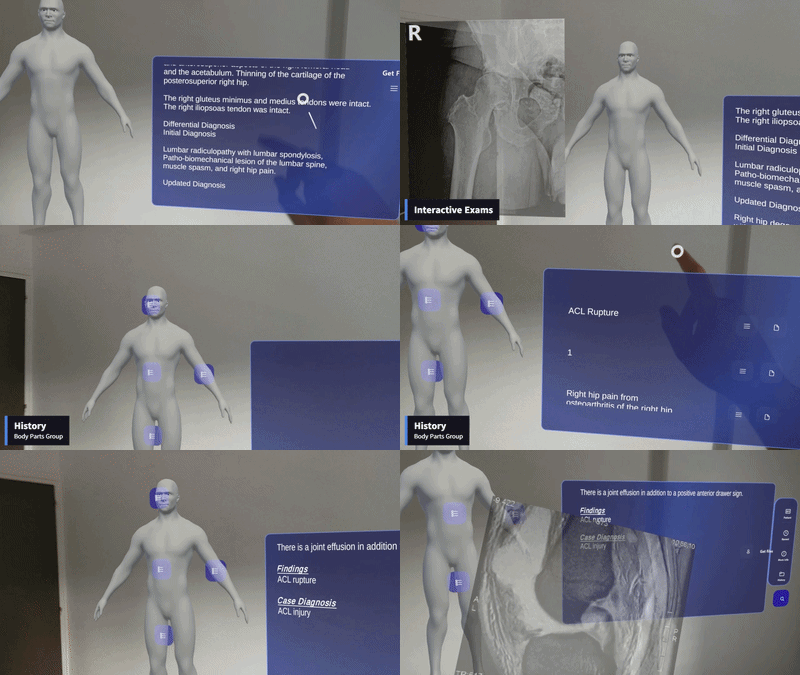
We present an MR-enhanced Electronic Health Record system that enables intuitive exploration of multimodal patient data through spatial, holographic interfaces. Our approach integrates clinical information, including 3D medical imaging, into an interactive mixed reality environment, demonstrating improved usability, anatomical understanding, and support for collaborative and patient-centered care.
Abstract
Electronic Health Records (EHRs) are essential to contemporary healthcare but remain limited by fragmented interfaces, poor usability, and inadequate support for complex multimodal data. Mixed Reality (MR) offers new opportunities to address these challenges, yet its integration into clinical information systems is largely unexplored. This paper presents the design and evaluation of a prototype MR-enhanced EHR that enables physicians to visualize and interact with patient data through holographic interfaces. Using MR glasses, clinicians access a three-dimensional representation of the patient’s body augmented with demographics, medical history, and diagnostic data, including 3D-rendered CT and MRI scans. Clinical information is spatially organized and accessed via gaze and gesture, supporting exploration and collaboration. A two-phase user study assessed requirements, usability, and clinical relevance. Results show strong acceptance among medical students and selective but promising interest among physicians, particularly for imaging, surgical planning, and patient communication. Overall, the findings indicate that MR-based EHRs can reduce cognitive load, improve anatomical understanding, and enhance collaborative and patient-centered care.
Main Contributions
- Identification of clinical user requirements for MR-based EHR integration, with a focus on usability, workflow compatibility, and data visualization.
- Design and implementation of a prototype MR--EHR system that presents medical data through immersive and interactive holographic interfaces.
- Evaluation of the system through a two-phase study, exploring MR’s potential to support information access, collaboration, and clinical decision-making.
Video
BibTeX
@inproceedings{Chaldoupis:2026,
 author    	= {Chaldoupis, Silouanos and Schizas, Eirini and Aristidou, Andreas},
 title     	= {Mixed Reality in Electronic Health Records: User Requirements and Evaluation},
 year 		= {2026},
 publisher 	= {IEEE},
 address 	= n/a,
 url 		= n/a,
 doi 		= n/a,
 booktitle 	= {Proceedings of the 39th IEEE International Symposium on Computer-Based Medical Systems},
 numpages 	= {8},
 keywords 	= {Mixed Reality, HoloLens, Electronic Health Record, Medical Education},
 location 	= {Limassol, Cyprus},
 series 	= {CMBS '26}
}
Acknowledgments
We sincerely thank all participants for their valuable contributions to the perceptual and evaluation studies.