
Let's All Dance: Enhancing Amateur Dance Motions
Overview
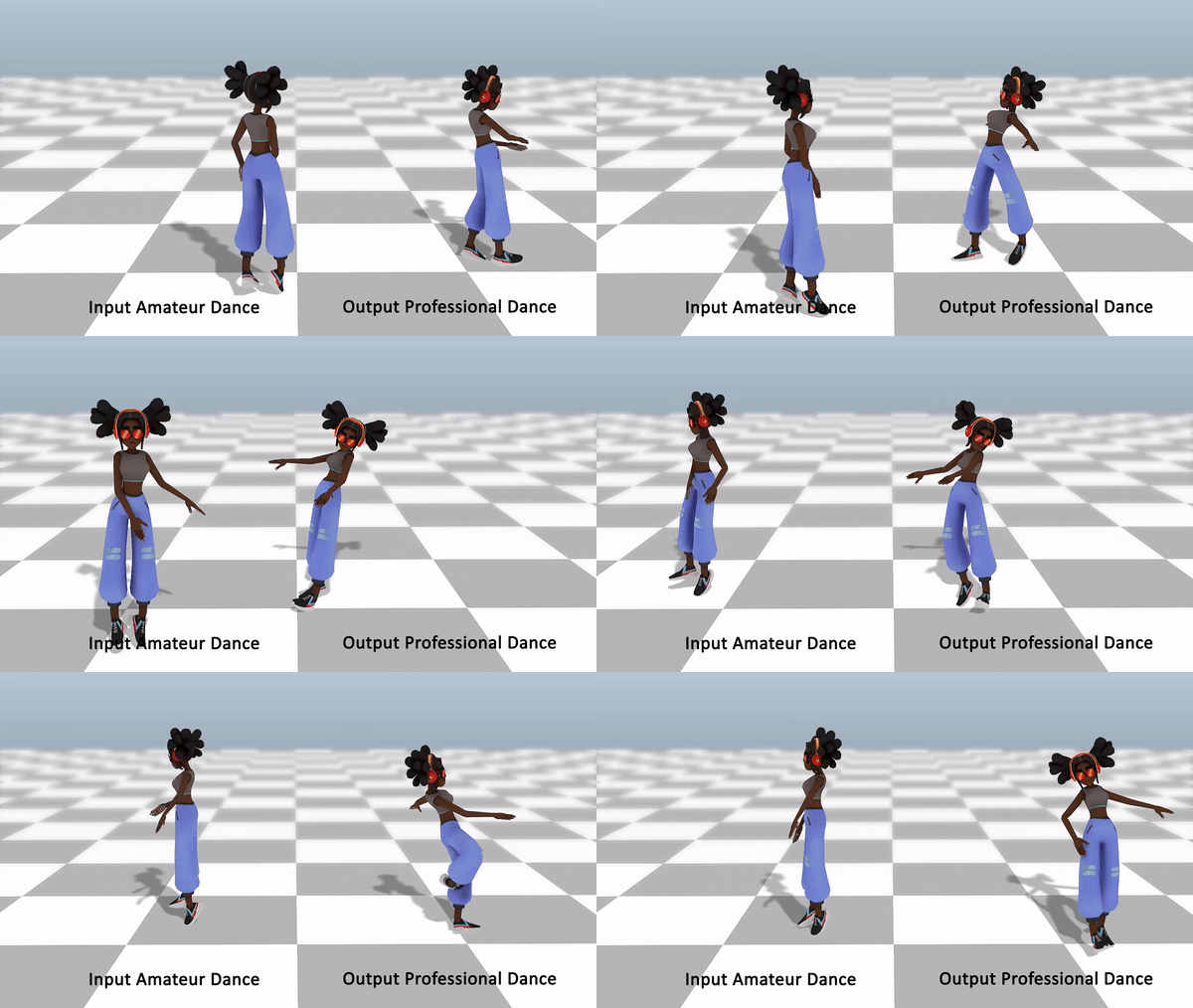
In this paper, we present a deep model that enhances professionalism to amateur dance movements, allowing the movement quality to be improved in both the spatial and temporal domains. We illustrate the effectiveness of our method on real amateur and artificially generated dance movements. We also demonstrate that our method can synchronize 3D dance motions with any reference audio under non-uniform and irregular misalignment.
Abstract
Professional dancing is characterized by high impulsiveness, elegance, and aesthetic beauty. In order to reach the desired professionalism, it requires years of long and exhausting practice, good physical condition, musicality, but also, a good understanding of the choreography. Capturing dance motions and transferring them into digital avatars is commonly used in the film and entertainment industries. However, so far, access to high-quality dance data is very limited, mainly due to the many practical difficulties in motion capturing the movement of dancers, which makes it prohibitive for large-scale acquisitions. In this paper, we present a model that enhances professionalism to amateur dance movements, allowing the movement quality to be improved in both the spatial and temporal domains. The model consists of a dance-to-music alignment stage responsible for learning the optimal temporal alignment path between the dance and music, and a dance-enhancement stage that injects features of professionalism in both the spatial and temporal domains. To learn a homogeneous distribution and credible mapping between the heterogeneous professional and amateur datasets, we generate amateur data from professional dances taken from the AIST++ dataset. We demonstrate the effectiveness of our method by comparing it with two baseline motion transfer methods via thorough qualitative visual controls, quantitative metrics, and a perceptual study. We also provide temporal and spatial module analysis to examine the mechanisms and necessity of key components in our framework.
Method Overview
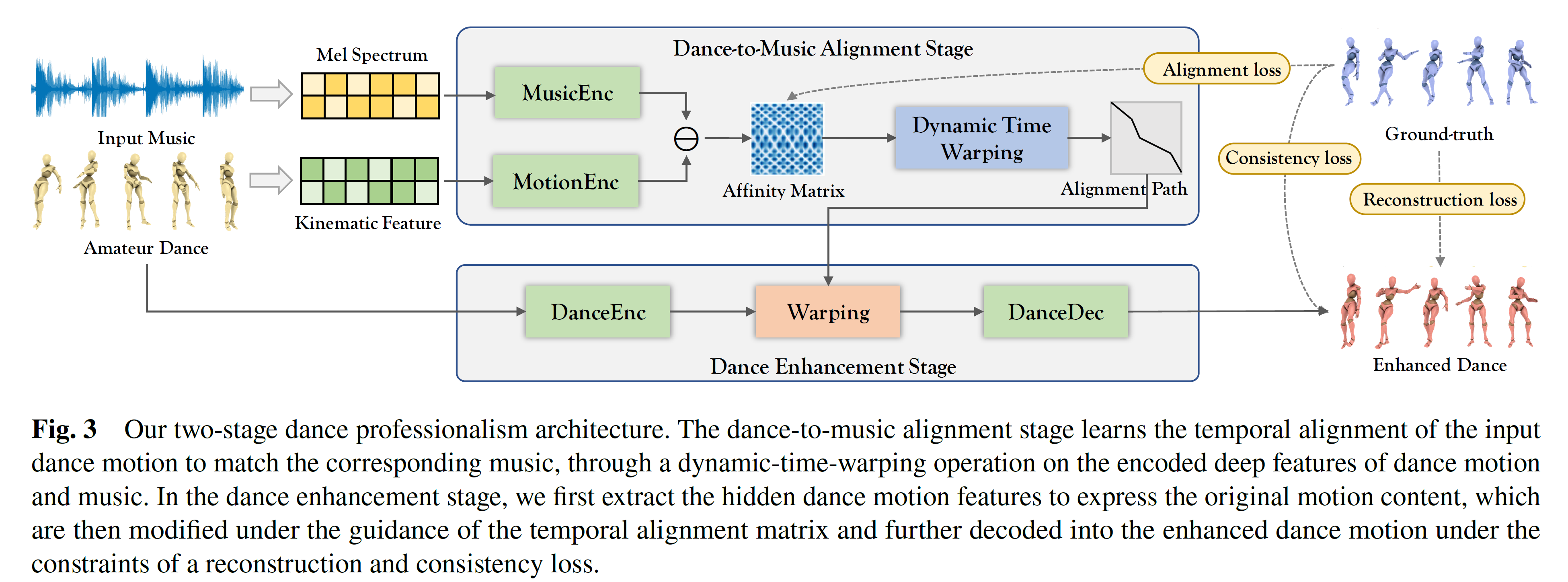
Figure 1: Our two-stage dance professionalism architecture. The dance-to-music alignment stage learns the temporal alignment of the input dance motion to the corresponding music, through a dynamic-time-warping operation on the encoded deep features of dance motion and music. In the dance enhancement stage, we first extract the hidden dance motion features to express the original motion content, which are then modified under the guidance of the temporal alignment matrix, and further decoded into the enhanced dance motion under the constraints of a reconstruction and consistency loss.
Main Contributions
- We introduce the concept of enhancing professionalism in dance movements and provide a first definition of what dance professionalism is and how a professional dance can be distinguished from an amateur one.
- We design a novel two-stage deep learning framework that extracts meaningful features from motion inputs, according to the newly defined professionalism criteria, to improve the quality of dance motions. It integrates a reconstruction loss to preserve the original content of the dance and a consistency loss to maintain the temporal coherency of the reconstructed motion.
- We propose a novel model designed to synchronize 3D dance motions with reference audio under non-uniform and irregular misalignment.
- We present thorough evaluations and an ablation study to examine the efficiency and necessity of our method.
Video
BibTeX
@article{Zhou:2023:LetsAllDance,
 author    	= {Zhou, Qiu and  Li, Manyi and Zeng, Qiong and Aristidou, Andreas and Zhang, Xiaojing and Chen, Lin and Tu, Changhe},
 title     	= {Let’s all dance: Enhancing amateur dance motions},
 journal   	= {Computational Visual Media},
 issue_date	= {September 2023},
 volume    	= {9},
 number    	= {3},
 month     	= {sep},
 pages		= {531--550},
 doi 		= {10.1007/s41095-022-0292-6},
 publisher 	= {Springer},
 address   	= {},
 year      	= {2023}
}
Acknowledgments
This research was supported by the grants of NSFC (No. 62072284), the grant of Natural Science Foundation of Shandong Province (No. ZR2021MF102), the Special Project of Shandong Province for Software Engineering (11480004042015), and internal funds from the University of Cyprus. The authors would like to thank Anastasios Yiannakidis (University of Cyprus) for capturing the amateur dances, Mingyi Shi (Hongkong University) for discussions, and the volunteers for attending the perceptual studies. The authors would also like to thank the anonymous reviewers and the editors for their fruitful comments and suggestions.