
Folk Dance Evaluation Using Laban Movement Analysis
Overview
We present a framework based on the principles of Laban Movement Analysis (LMA) that aims to identify style qualities in dance motions, and can be subsequently used for motion comparison and evaluation. We have designed and implemented a prototype virtual reality simulator for teaching folk dances in which users can preview dance segments performed by a 3D avatar and repeat them. The user's movements are captured and compared to the folk dance template motions; then, intuitive feedback is provided to the user based on the LMA components.
Other Related Publications
Abstract
Motion capture (mocap) technology is an efficient method for digitizing art performances, and is becoming increasingly popular in the preservation and dissemination of dance performances. Although technically the captured motion can be of very high quality, dancing allows stylistic variations and improvisations that cannot be easily identified. The majority of existing motion analysis algorithms are based on ad-hoc quantitative metrics, thus do not usually provide insights on style qualities of a performance. In this work we present a framework based on the principles of Laban Movement Analysis (LMA) that aims to identify style qualities in dance motions. The proposed algorithm uses a feature space that aims to capture the four LMA components (Body, Effort, Shape, Space), and can be subsequently used for motion comparison and evaluation. We have designed and implemented a prototype virtual reality simulator for teaching folk dances in which users can preview dance segments performed by a 3D avatar and repeat them. The user's movements are captured and compared to the folk dance template motions; then, intuitive feedback is provided to the user based on the LMA components. The results demonstrate the effectiveness of our approach and open new horizons for automatic motion and dance evaluation processes.

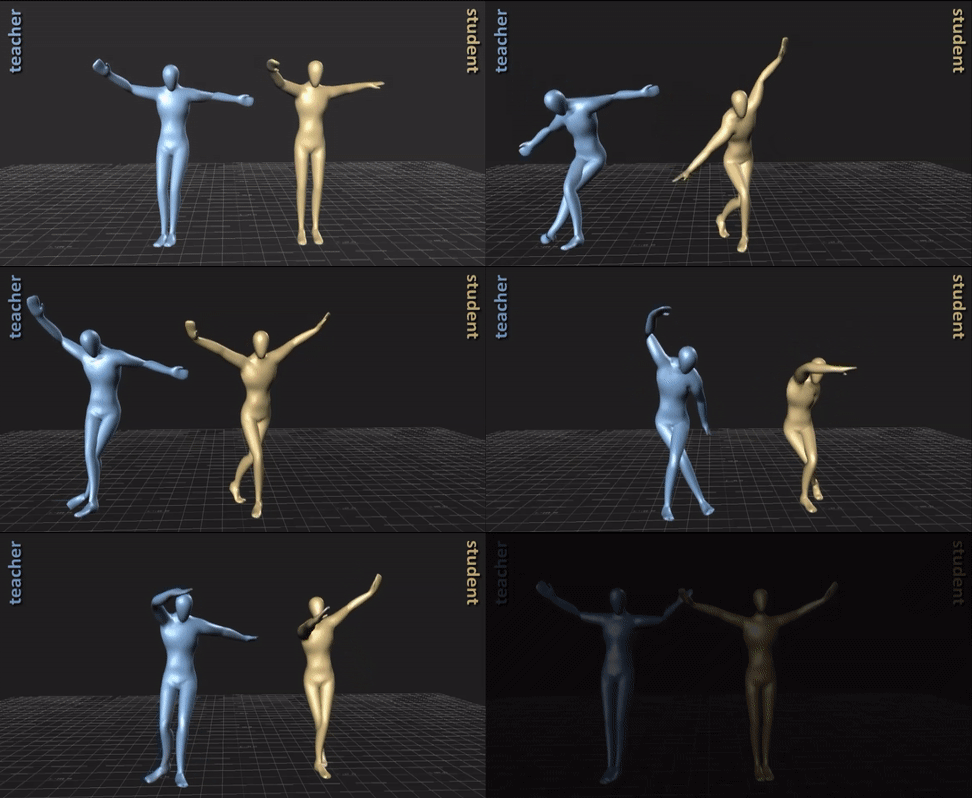
Figure: This figure shows snapshots from our experimental data, where the student (yellow) imitates the teacher’s (blue) movements.
Video
BibTeX
@article{Aristidou:2015:JOCCH,
 author    	= {Aristidou, Andreas and Stavrakis, Efstathios and Charalambous, Panayiotis and Chrysanthou, Yiorgos and Loizidou-Himona, Stephania},
 title 		= {Folk Dance Evaluation Using {L}aban {M}ovement {A}nalysis},
 journal 	= {J. Comput. Cult. Herit.},
 issue_date	= {August 2015},
 volume 	= {8},
 number 	= {4},
 month 		= aug,
 year 		= {2015},
 issn 		= {1556-4673},
 pages 		= {20:1--20:19},
 articleno 	= {20},
 numpages 	= {19},
 url 		= {http://doi.acm.org/10.1145/2755566},
 doi 		= {10.1145/2755566},
 acmid 		= {2755566},
 publisher 	= {Association for Computing Machinery},
 address 	= {New York, NY, USA},
}
Acknowledgments
This work is co-financed by the European Regional Development Fund and the Republic of Cyprus through the Research Promotion Foundation under contract ΔΙΔΑΚΤΩΡ/0311/73.
