
Digital Dance Ethnography: Organizing Large Dance Collections
Overview
This work presents a method for contextual motion analysis that organizes dance data semantically, enabling the first digital dance ethnography. It can exploit contextual correlations between dances and distinguish fine-grained differences between semantically similar motions. The approach reveals chronological and geographical evolution relationships within large dance collections, using motif-based signatures and a hierarchical organization process.
Abstract
Folk dances often reflect the socio-cultural influences prevailing in different periods and nations; each dance produces a meaning, a story with the help of music, costumes and dance moves. However, dances have no borders; they have been transmitted from generation to generation, along different countries, mainly due to movements of people carrying and disseminating their civilization. Studying the contextual correlation of dances along neighboring countries, unveils the evolution of this unique intangible heritage in time, and helps in understanding potential cultural similarities. In this work we present a method for contextually motion analysis that organizes dance data semantically, to form the first digital dance ethnography. Firstly, we break dance motion sequences into some narrow temporal overlapping feature descriptors, named motion and style words, and then cluster them in a high-dimensional features space to define motifs. The distribution of those motion and style motifs creates motion and style signatures, in the content of a bag-of-motifs representation, that implies for a succinct but descriptive portrayal of motions sequences. Signatures are time-scale and temporal-order invariant, capable of exploiting the contextual correlation between dances, and distinguishing fine-grained difference between semantically similar motions. We then use quartet-based analysis to organize dance data into a categorization tree, while inferred information from dance metadata descriptions are then used to set parent-child relationships. We illustrate a number of different organization trees, and portray the evolution of dances over time. The efficiency of our method is also demonstrated in retrieving contextually similar dances from a database.
Similarity Visualizations


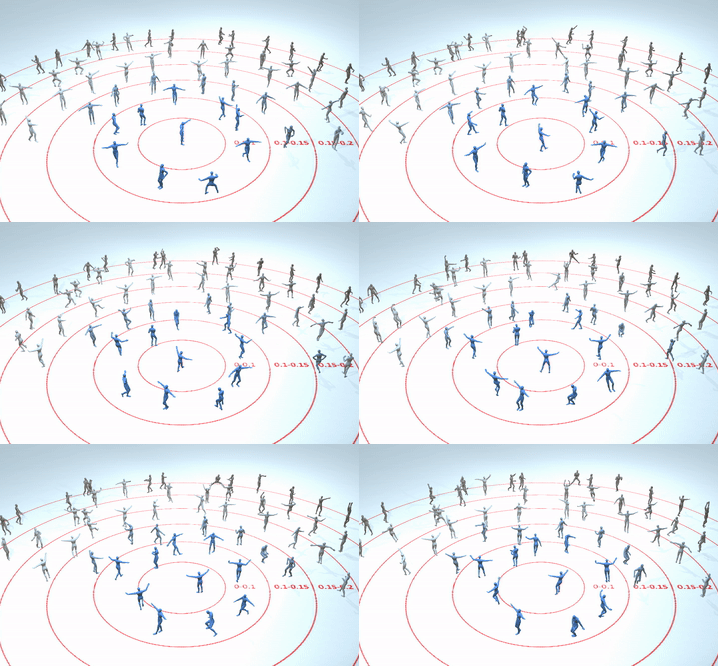
These animated figures demonstrate, in a circular partition, the degree of similarity of the Salsa (left) and Hasaposerviko (right) dances to other dances in the collection. Similar dances to the query dance are placed closer to the center circle. The similarity is also illustrated by different shades of green (for Salsa) and blue (for Hasaposerviko); the numbers in red indicate the degree of dissimilarity for that partition.
Main Contributions
- We have introduced the algorithmic framework for contextual analysis, organization, and comparison of dances.
- We have defined motion and style signatures, a succinct and descriptive high-level representations of dance motion sequences, that reflect the distribution of motion and style motifs found in the sequences.
- We have enriched the Dance Motion Capture Database with a large number of high quality folk dances originated from the wider region of the eastern Mediterranean, the Balkans and Pontus.
- We have described how dance motion can be acquired and documented holistically so as to enable the extraction of semantic, cultural, and contextual correlations.
- We have identified which metadata are useful for archiving, curating, presenting and re-using dance motion data.
- We have designed a holistic metadata scheme to drive further studies of dances from an anthropology, and ethnology perspective.
- We have defined semantic links that create parent-child relationships, in a hierarchical mode, to establish chronological and geographical correlations in our dance collection, paving the way for creating the first digital dance ethnography.
- We have visualized the chronological and geographical evolution of dances (for the limited size of our database).
Video
BibTeX
@article{Aristidou:2019:DanceEthnography,
 author    	= {Aristidou, Andreas and Shamir, Ariel and Chrysanthou, Yiorgos},
 title 		= {Digital Dance Ethnography: {O}rganizing Large Dance Collections},
 journal 	= {J. Comput. Cult. Herit.},
 issue_date	= {January 2020},
 volume 	= {12},
 number 	= {4},
 month 		= nov,
 year 		= {2019},
 issn 		= {1556-4673},
 articleno	= {29},
 numpages 	= {27},
 url 		= {https://doi.org/10.1145/3344383},
 doi 		= {10.1145/3344383},
 acmid 		= {},
 publisher	= {Association for Computing Machinery},
 address 	= {New York, NY, USA},
}
Acknowledgments
The authors thank the Cyprus Folklore Research Association and all dancers and performers who contributed to the recordings. This work was supported by the RESTART 2016–2020 Programme for Technological Development and Innovation, the Cyprus Research Promotion Foundation (P2P/JPICH_DH/0417/0052), the EU Horizon 2020 programme (Grant 739578), and the Government of Cyprus through the Directorate General for European Programmes, Coordination and Development. NVIDIA kindly donated the Titan Xp GPU used in this project.